
Siding That Holds Up Without Constant Upkeep
Vinyl siding in Central and Costal Maine for homes showing warped, cracked, or failing exterior cladding that is allowing moisture into the wall assembly
Exterior cladding that has begun to warp, crack, or pull away from the wall surface does more than affect how a home looks—it breaks the barrier between the finished interior assembly and the moisture that works through gaps at joints and fastener holes. High-grade vinyl siding, installed correctly over a properly prepared substrate, eliminates those entry points and produces a finished exterior that does not require painting cycles, is not vulnerable to wood rot, and does not soften or deform when temperature swings are extreme. ABL Roofing installs vinyl siding in Central and Costal Maine from their Pittston location for homeowners whose existing exterior has reached the point where repairs no longer address the underlying failure pattern.
The installation sequence for vinyl siding begins with stripping the existing cladding to assess what is happening to the sheathing and housewrap beneath. Older Central and Costal Maine homes—particularly those built in the mid-twentieth century with minimal insulation in the wall cavity—frequently show moisture accumulation behind the original siding that has softened the sheathing, and that condition must be corrected before new material is hung. New housewrap or building wrap goes in before panels, window and door flanges are properly integrated into the water-resistive barrier, and panels are fastened with the correct nailing slot allowance so the material can move laterally without buckling.
Schedule an exterior assessment to determine the condition of the sheathing beneath your current siding before committing to a material selection.
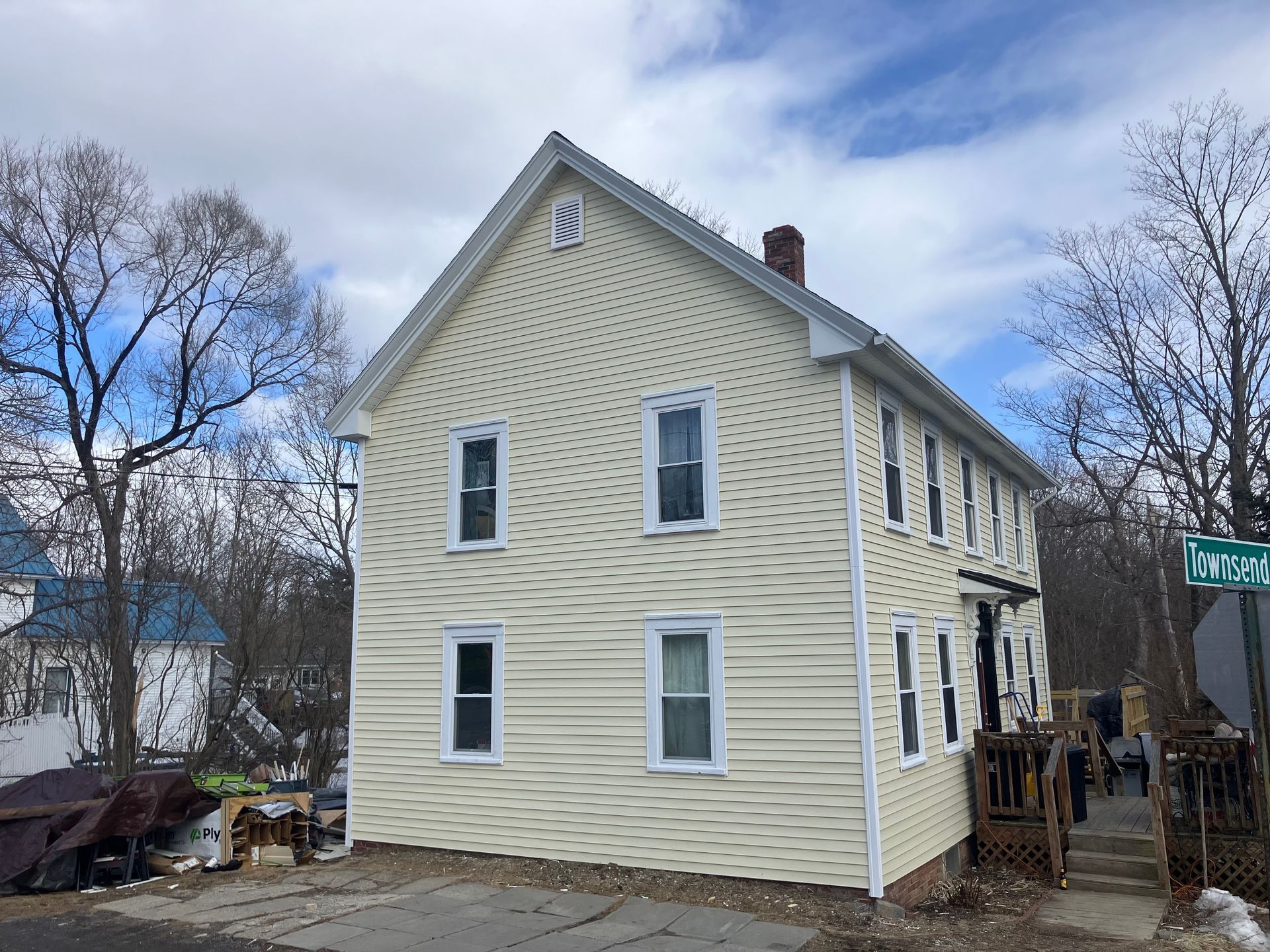
The Difference Between High-Grade Vinyl and Builder-Grade Material
Vinyl siding is sold across a wide range of thicknesses and profile rigidity, and the difference between a product that holds its shape over decades and one that becomes brittle and cracks within a few years is measurable in panel thickness and UV stabilizer content. Thicker panels—typically .044 inches and above—resist the flex and impact that thinner builder-grade profiles cannot handle under high wind loading or direct impact. ABL Roofing selects siding products appropriate to the exposure conditions of each installation rather than defaulting to the minimum specification.
After a completed vinyl siding installation, the exterior of the home will show clean, consistent panel alignment with no visible gaps at corners, J-channels, or around window and door openings. The interior walls adjacent to the exterior should no longer show any evidence of moisture infiltration, and the home's thermal performance typically improves when the installation includes continuous insulated underlayment beneath the siding panels—a step that also adds rigidity to the finished panel surface.
Vinyl siding does not require painting and is cleaned with a garden hose and mild detergent when surface oxidation or pollen accumulation is visible. The primary maintenance consideration is keeping soil and mulch from piling against the bottom course, which traps moisture against the lowest panels and can cause the lower edge to sit in standing water after rain events.
Answers About How the Siding Work Is Done
Vinyl siding installation involves decisions about substrate preparation, material specification, and integration at windows and doors that determine how well the finished product performs. The questions below address those specifics.
- What happens to the sheathing and housewrap when old siding is removed? Stripping existing cladding exposes whatever was used as a water-resistive barrier when the home was originally sided, which in older Central and Costal Maine homes is often a degraded felt paper or an early-generation housewrap that is no longer continuous or properly lapped. Any damaged sheathing panels are replaced at this stage, and new housewrap is installed before any new material is hung.
- How is vinyl siding fastened to allow for thermal movement without buckling? Vinyl panels expand and contract measurably as temperature shifts, so fasteners are driven through the center of the nail slot—never at the slot ends—and left with a small gap between the fastener head and the panel surface. This allows the panel to shift horizontally without the fastener restraining it, which prevents the rippling and buckling that appears on siding that was face-nailed tightly.
- Why does the integration at windows and doors matter more than the field installation? The field panels on a vinyl siding job are straightforward to install, but every window and door opening is a point where water can run behind the cladding if the J-channel and flange details are not sequenced correctly into the water-resistive barrier. Improperly integrated openings allow water to work into the wall cavity directly, which is the most common source of moisture damage behind vinyl siding on older homes.
- What is the correct way to evaluate whether vinyl siding was installed properly at the corners and trim? Finished corners should be plumb, fully engaged over the panel ends with no gaps, and not pulling away from the wall surface. J-channel at windows should lap over the horizontal flashing above the unit rather than sitting against it, and there should be no caulk filling gaps that should have been covered by properly sequenced trim pieces.
- How long does vinyl siding typically perform before it needs replacement? Premium-grade vinyl siding with adequate UV stabilizer content has a service life of several decades when installed correctly and not subjected to sustained physical impact. The early indicators of material degradation are chalking on the surface and hairline cracking at panel ends—conditions that appear well before the product fails structurally and provide time to plan a replacement installation.
ABL Roofing manages vinyl siding projects from substrate assessment through final trim installation so the finished exterior performs as a complete system rather than a collection of individual components. Arrange a consultation with ABL Roofing to review your exterior conditions and go over material options suited to your home.