
Shingles That Hold Through Serious Conditions
Asphalt shingles in Central and Costal Maine for homes showing worn, cracked, or aging roof surfaces after decades of real use
ABL Roofing installs asphalt shingles for homeowners in Central and Costal Maine whose roofs are showing wear consistent with the area’s older housing stock. Many properties in and around Pittston were built in eras when shingle quality and installation practices differed substantially from current material standards, leaving a large portion of the local housing inventory due for a full replacement. When original shingles begin to curl at the corners, lose granule adhesion, or separate at the sealing strip, the roof deck beneath is already absorbing moisture it was not designed to handle.
The installation process begins with removing existing shingle layers down to the decking, inspecting each section for soft spots, rot, or fastener damage before any new material is applied. ABL Roofing selects shingles rated for the weight loads and structural demands that older Maine farmhouses and cape-style homes typically place on a roof system. Architectural shingles, available in a range of profiles and colorways, are the standard choice for most Pittston properties because their laminated construction resists uplift and performs consistently on the steeper pitches common in New England residential construction of that era.
Arrange a roof evaluation to assess the current condition of your shingles and decking before the next season of heavy loading begins.
What Asphalt Shingles Actually Accomplish
Modern asphalt shingles function as a layered moisture management system, not simply a surface covering. Each course overlaps the one below by a calculated amount, routing water off the deck and into the gutters in a controlled path rather than allowing lateral migration. On Central and Costal Maine homes with steeper pitches common in older New England farmhouse construction, that overlap distance and the quality of the starter strip installation directly determine whether ice buildup at the eave ever reaches the decking below it.
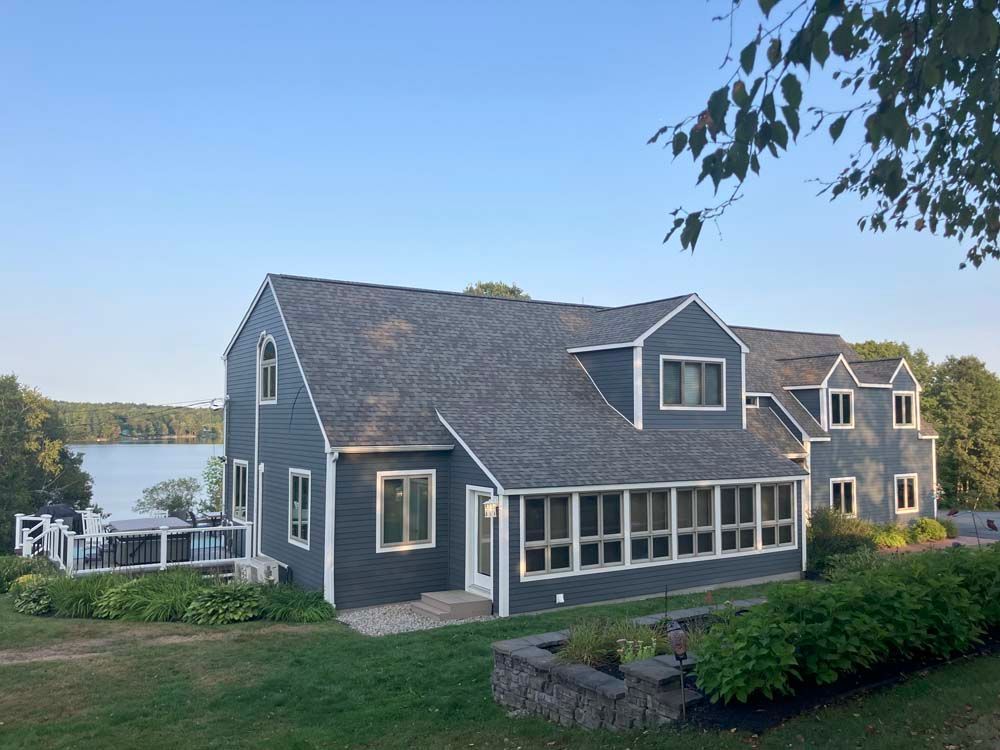
After a proper installation, the most visible change is uniformity: no lifted corners, no bare patches where granules have released, no visible gaps at the ridge cap. Downspouts run clean water during rain events rather than granule-heavy discharge, which indicates the surface coating is holding. Inside the home, attic condensation typically drops when the new roof system is sealed and ventilated correctly, because air movement through the assembly is restored.
Shingle selection also involves matching the product’s wind resistance rating to the roof’s exposure and pitch. Sections with low-slope transitions over additions or dormers require additional underlayment or ice-and-water shield to function correctly within the overall system. ABL Roofing evaluates each roof plane separately rather than applying a single specification across the entire job.
Common Questions About Asphalt Shingle Installation
Property owners in Central and Costal Maine frequently ask about what the shingle replacement process involves and what to look for once the work is complete.
- What happens to the old shingles before new ones go down? The existing shingle layers are removed to the decking so the surface can be inspected for rot, delamination, or fastener damage before any new material is applied.
- How does decking condition affect the installation process? Soft or water-damaged decking boards must be replaced before new shingles are installed, because shingles fastened to compromised decking will not hold correctly over time.
- What determines how many shingle layers a roof can carry? Most building codes limit a roof to two shingle layers before a full tear-off is required, and older Pittston homes may already have one existing layer beneath the visible surface.
- Why does the starter strip matter at the eave line? The starter strip creates the sealed edge at the lowest course and prevents wind-driven water from working back under the first shingle row, where a gap allows direct water entry to the decking below.
- What does a correctly installed shingle course look like once the job is finished? Properly installed shingles lie flat across each course, align at consistent horizontal offsets between rows, and show no lifted tabs or exposed nailing along the rake edges.
ABL Roofing works with homeowners in Central and Costal Maine to select and install asphalt shingles suited to the specific pitch, age, and structural conditions of each property. Request a detailed estimate based on your current roof configuration to get the process started.