
Flat Roofs That Stay Watertight Under Load
Flat and rubber roofing in Central and Costal Maine for standing water, heavy snow accumulation, and membrane failures that compromise the building below
Pooling water on a flat roof is not a drainage inconvenience—it is weight the structure was not designed to hold indefinitely, and it is the primary mechanism by which flat roof membranes fail ahead of schedule. ABL Roofing installs flat and rubber roofing systems in Central and Costal Maine from their Pittston location for commercial buildings, additions, and residential structures where pitch is insufficient for conventional shingle application, using membrane systems designed to maintain a continuous watertight barrier rather than relying on overlapping layers that can be compromised at seams.
Modern rubber roofing—EPDM in particular—is installed as a single continuous sheet across the field of the roof, which eliminates the staggered seam pattern that creates entry points in older built-up systems. Where seams are unavoidable at edges, drains, and penetrations, those transitions are sealed with compatible bonding adhesives and reinforced tape designed to remain flexible through repeated expansion and contraction cycles. The installation sequence matters: the substrate must be clean, dry, and structurally sound before membrane adhesion, because a rubber membrane bonded to a compromised deck will fail at the deck level rather than at the surface.
Set up a site evaluation to review your current flat roof condition and determine what system is appropriate for the structure.
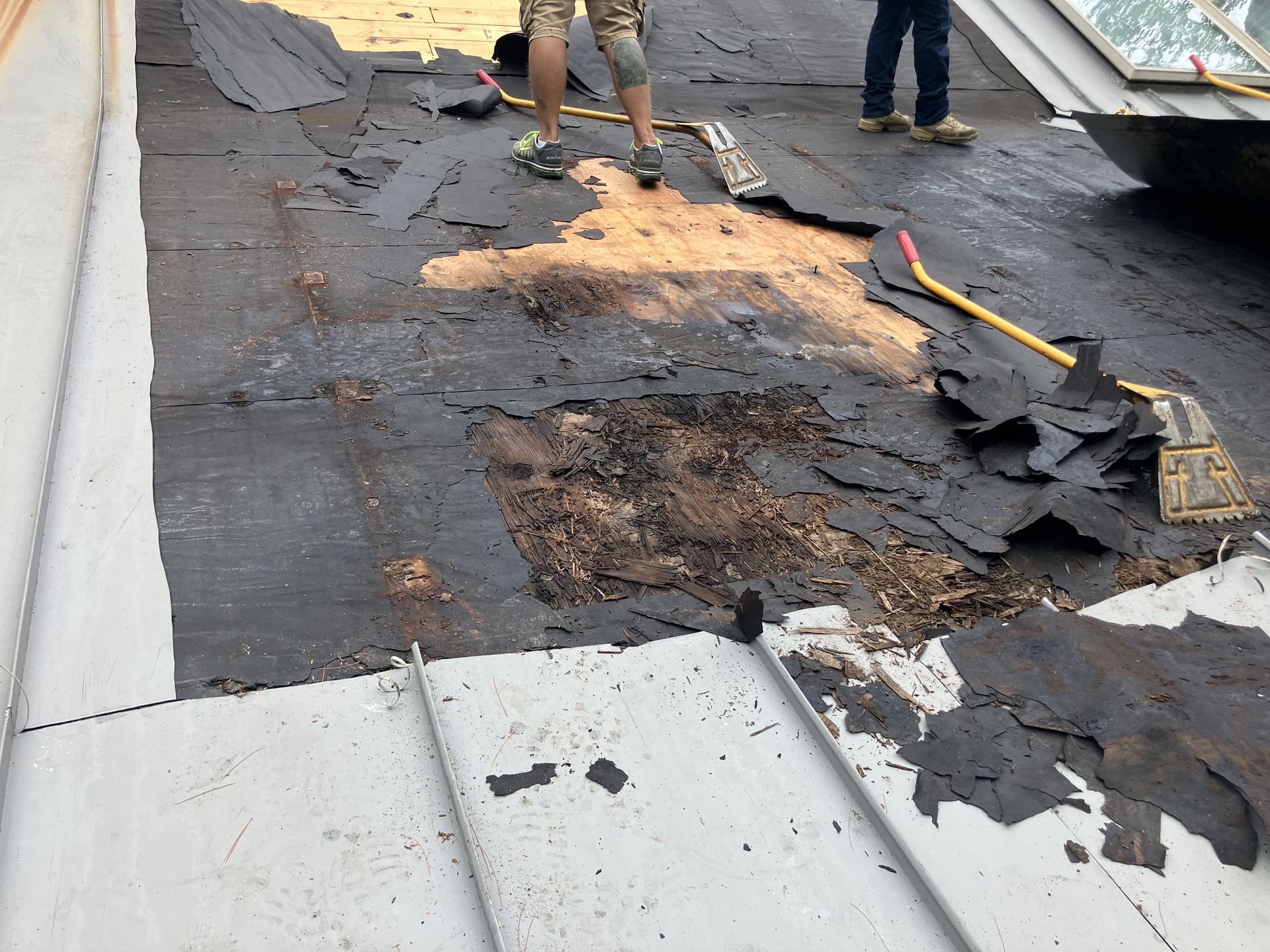
What a Properly Installed Membrane System Accomplishes
Flat and rubber roofing systems work by creating a monolithic barrier rather than a layered system dependent on shingle overlap. During installation, ABL Roofing addresses the details that determine long-term performance: drain placement and pitch toward them, edge termination at parapet walls and fascia, and the handling of every penetration—HVAC curbs, exhaust vents, skylights—where the membrane must transition around a vertical element. These penetration details are where the majority of flat roof failures originate, and they require specific flashing collars and sealant systems compatible with the membrane material.
After a correctly installed flat or rubber roof, standing water should migrate toward drains within the designed drainage time rather than pooling indefinitely, and the interior ceiling below the roof should remain completely dry even after heavy precipitation or significant snowmelt. The membrane surface itself should be smooth and fully adhered with no bubbling or lifting at field seams or edges—any of those conditions on an existing roof indicates adhesion failure and an active leak risk.
Flat roofs on Central and Costal Maine properties also contend with the compressive weight of heavy snow accumulation, which places stress on both the membrane and the deck structure beneath it. A properly specified system accounts for the load path and ensures the deck substrate can handle that stress without deflecting in ways that break membrane adhesion at seams or drains.
What Property Owners Ask About Flat Roof Systems
Flat and rubber roofing involves different materials, installation methods, and maintenance considerations than sloped systems. The questions below address how this type of roofing actually works.
- What is the difference between EPDM rubber roofing and older built-up flat roof systems? EPDM is a single-ply membrane applied as one continuous sheet, which reduces the number of seams and lap joints compared to built-up systems that are assembled in multiple layers with each layer introducing potential separation points. The single-ply approach also makes repairs more straightforward because the failure point is visible and accessible at the surface.
- How does water pooling affect a flat roof membrane over time? Standing water adds direct weight load and, when it sits at seams and termination edges, works through capillary action to test adhesion. Over repeated cycles, the constant saturation degrades the bonding layer and causes membrane edges to lift, which allows water to migrate beneath the field of the roof rather than shedding off the surface.
- Why do penetrations fail more often than the open field of a flat roof? The flat field of an EPDM membrane is under uniform conditions, but every penetration—pipe boot, vent collar, drain ring—is a point where the membrane must bond to a dissimilar material in a complex geometry. Thermal movement stresses those joints differently than the open field, and if the flashing collar is not compatible with the membrane material, differential expansion breaks the seal.
- What substrate conditions need to be present before a rubber membrane is installed? The deck must be structurally sound, free of soft spots, and dry at the time of adhesion. Any existing insulation that has absorbed moisture must be replaced because membrane adhesive will not bond reliably to a wet or degraded surface, and trapped moisture beneath the new membrane will cause blistering and adhesion failure.
- How does a property owner check whether a flat roof is holding up correctly between professional inspections? Walk the surface after a dry period and check for bubbles or areas where the membrane lifts when pressed—those indicate adhesion failure beneath. Check interior ceiling surfaces below the roof after rain events for any new moisture activity, and inspect drain areas for debris accumulation that would cause pooling to persist beyond the designed drainage time.
ABL Roofing approaches flat and rubber roofing installations with the penetration and edge details that determine whether a membrane system performs for its full service life. Contact ABL Roofing to schedule an assessment of your flat roof and discuss which membrane system fits the structure.