
Stop Roof Damage Before It Spreads
Roof repairs in Central and Costal Maine for active leaks, storm damage, and structural deterioration before interior damage sets in
A ceiling stain is rarely where the problem starts. Water travels along roof decking, rafters, and insulation before it ever appears on a finished surface inside the home, which means the visible drip point can be several feet from the actual breach. ABL Roofing provides roof repair in Central and Coastal Maine from their Pittston location with a diagnostic approach designed to locate the true source of a leak rather than patching the nearest visible symptom and walking away.
The repair process begins with a thorough inspection of the roof system—shingles, flashing, valleys, ridge caps, and penetrations around chimneys or vents—to determine where water is entering and what condition the underlying decking is in. If immediate stabilization is needed to stop active water intrusion while a full repair plan is assembled, that step is handled first so the structure does not continue to absorb moisture. Ice damming, branch impact, and wind-driven rain each create different damage signatures, and identifying which force caused the failure shapes which materials and methods the repair requires.
Request a roof inspection to document current damage and identify what repairs are needed before the next rain event.
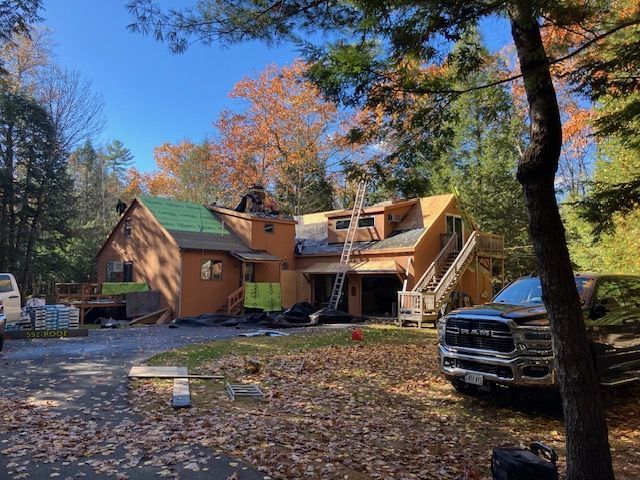
How Repairs Protect What a Full Replacement Would Cost
Roof repairs done correctly address the cause rather than the symptom. That means replacing compromised flashing rather than caulking over it, renailing lifted sections rather than layering new material over unstable existing shingles, and replacing any decking that has absorbed moisture long enough to lose structural integrity. ABL Roofing treats each repair as a decision point: what can be preserved, what must be replaced, and where deferred work will create a larger failure within one or two seasons.
After a properly completed repair, the areas that were leaking will be dry, the flashing will sit flush against adjacent surfaces, and any soft or spongy decking will have been replaced with solid substrate. Homeowners typically notice that attic spaces stop showing daylight through the roof structure, and interior water staining does not grow after the next rainfall. These are the indicators that the repair addressed the source rather than the surface.
Repairs also extend the service life of roofs that are structurally sound but showing localized wear. A roof that loses one valley or one flashing run prematurely does not necessarily need full replacement if the remaining field is in good condition—targeted repairs preserve that investment and defer the cost of a full system until the rest of the roof has reached the end of its useful life.
Common Questions About Roof Repair Work
Homeowners in Central and Coastal Maine often have specific questions about what a roof repair involves and how to evaluate whether the work has fully resolved the problem. The answers below address the repair process itself.
- What does a roof diagnostic inspection actually examine? An inspection covers the full roof surface including all flashing at transitions, valleys, and penetrations, the ridge and hip caps, and any areas where materials have lifted, cracked, or separated. On older homes, the inspection also checks for soft decking beneath the surface layer, since saturated wood does not always show from outside.
- How is the true source of a leak identified when the interior damage point is misleading? Water follows the path of least resistance along the roof plane and framing members, so tracing it backward from the interior stain requires checking every penetration and transition uphill from where the water appears inside. In most cases, the actual entry point is a failed flashing detail or a cracked shingle in a valley rather than directly above the visible ceiling damage.
- What happens to decking that has absorbed moisture before a repair is made? Decking that has softened or delaminated cannot hold fasteners reliably and must be cut out and replaced with matching-thickness material before new surface layers are installed. Leaving compromised decking under new shingles shortens the life of the repair and can void manufacturer installation requirements.
- When does a repair stop being adequate and require a full replacement instead? A repair is appropriate when damage is localized and the surrounding roof field remains structurally sound and has meaningful service life remaining. When granule loss is uniform across the surface, when multiple sections are showing the same failure pattern simultaneously, or when decking is compromised in multiple zones, a full replacement addresses the root condition more effectively than successive repairs.
- What should a homeowner look for after a repair is completed to confirm it was done correctly? Flashing should sit tight against adjacent surfaces with no visible gaps, repaired shingle sections should align with the surrounding field without raised edges, and any replaced decking areas should feel firm underfoot if accessible. After the next rainfall, the previously affected interior areas should show no new moisture activity.
ABL Roofing works through the repair process systematically so homeowners understand what was found, what was done, and what to watch for going forward. Arrange a diagnostic inspection to get a clear picture of your roof's current condition and what it needs.